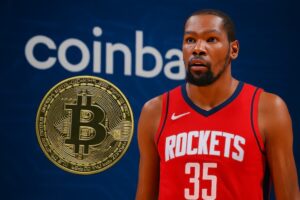
 Kevin Durant, one of the brightest stars in the NBA, has finally managed to regain access to a Bitcoin investment he made years ago. After struggling for a long time with his Coinbase account, Durant’s recovery of his funds has caught the attention of the crypto community, shedding light on both the challenges faced by investors and the dramatic rise in Bitcoin’s value over the years.
Kevin Durant’s First Step into Bitcoin
Durant’s interest in the crypto world dates back to 2015–2016, when Bitcoin was far from the mainstream popularity it enjoys today. At the time, he made his first purchases through Coinbase, reportedly investing just a few thousand dollars.
Considering Bitcoin was trading at only a few hundred dollars per coin back then, Durant’s move was seen as a visionary step. Today, that modest investment has multiplied into millions of dollars thanks to Bitcoin’s remarkable price growth.
Durant’s early leap not only positioned him as a forward-looking investor but also made him one of the most notable NBA players associated with cryptocurrency.
How Did Kevin Durant’s Coinbase Account Get Locked?
The reason Durant’s Bitcoin remained “untouchable” for years was that he had lost access to his Coinbase account. Reports suggest the star athlete simply forgot his login credentials, a problem that has plagued many in the crypto community. Without passwords or recovery details, investors often end up locked out of fortunes for years.
Like many others, Durant faced Coinbase’s strict security and verification procedures, which are designed to protect users. But these processes can be long and difficult, leading to accounts being inaccessible for extended periods of time. His case underscores the delicate balance between security and accessibility in the world of crypto.
Brian Armstrong Confirms: “Account Recovered”
After years of being locked out, Durant’s Coinbase account was finally recovered. The confirmation came directly from Coinbase CEO Brian Armstrong, who announced on social media that Durant’s account was now accessible again.
The statement quickly spread across the crypto space, serving as proof that even high-profile investors can face access issues. Armstrong’s announcement also highlighted the importance of Coinbase’s security and account recovery protocols.
For many, Durant’s case was seen as a rare success story, giving hope that lost crypto holdings on centralized exchanges could sometimes be restored.
The Current Value of Durant’s Bitcoin Investment
Although the exact size of Durant’s original investment is unclear, reports estimate it was only a few thousand dollars back in 2015–2016. At the time, Bitcoin’s price was hovering between $300 and $400.
Fast forward to 2025, with Bitcoin trading at around $60,000, that same investment could now be worth millions.
Durant’s account recovery is not just a personal victory but also a striking example of the long-term potential of cryptocurrency investments. Many in the crypto community hailed the story as “a reward for patient investors.”
Celebrity Investments in the Crypto World
Kevin Durant’s Bitcoin journey is just one chapter in the growing connection between celebrities and crypto. Over the past decade, countless athletes and entertainers have diversified their portfolios with digital assets.
-
Tom Brady launched his own NFT platform while actively investing in Bitcoin.
-
Lionel Messi received part of his PSG signing bonus in crypto.
-
NBA legends like Shaquille O’Neal and Steph Curry have been involved in various blockchain and NFT projects.
These examples prove that crypto is no longer just a niche interest for tech enthusiasts—it has become a significant part of mainstream culture and global sports. Durant’s Coinbase story illustrates both the opportunities and risks celebrities face in the digital asset space.
A Lesson for Investors: Wallet Security and Recovery
Durant’s reunion with his Bitcoin also carries a critical lesson for investors: losing access credentials can happen to anyone. In the crypto world, the saying goes, “Not your keys, not your coins.” Without private keys or recovery details, assets are often lost forever.
Durant was fortunate to be using a centralized exchange like Coinbase, where recovery was possible. But in the case of self-custodial wallets, such recovery is virtually impossible.
This makes it essential for investors to secure their wallets, back up recovery phrases, and safeguard login credentials. Durant’s experience demonstrates both the power of holding Bitcoin long-term and the importance of proper security practices in protecting one’s digital wealth.