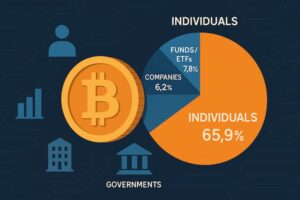
 Bitcoin continues to be one of the most talked-about assets in global finance in 2025. Beyond price swings, the key question now is: “Who really owns Bitcoin?” A new report by River shows that nearly two-thirds of the supply is still held by individuals. At the same time, institutional investors, public companies, and sovereign governments are steadily building their reserves — signaling that the ownership map may look very different in the near future.
Ownership Breakdown: Individuals Lead, Institutions Rising
The numbers reveal that Bitcoin remains largely retail-driven. According to River’s data, 65.9% of Bitcoin is held by individuals. This underscores how millions of small investors still account for the bulk of ownership.
But the balance is changing. Funds now hold 7.8%, corporations 6.2%, and governments 1.5%. The rise of institutional funds and publicly listed companies marks Bitcoin’s transformation from a retail-driven asset into a bona fide part of global finance.
The remainder is tied up in lost coins or unclassified wallets, a reminder that the effective circulating supply is even more limited than it seems.
Global Bitcoin Ownership (2025)
| Owner Group | Share (%) |
|---|---|
| Individuals | 65.9% |
| Funds / ETFs | 7.8% |
| Corporations | 6.2% |
| Governments | 1.5% |
| Other (lost / unknown) | ~18.6% |
Whales and Major Holders: From Satoshi to Corporations
In Bitcoin’s ecosystem, certain wallets are large enough to move markets on their own. These so-called “whales” dominate the ownership landscape.
-
Satoshi Nakamoto
The mysterious creator is believed to hold about 968,000 BTC, coins that have remained untouched for years — a dormant giant in the crypto economy. -
Strategy (formerly MicroStrategy)
With roughly 597,000 BTC as of 2025, it is by far the largest public company holder. -
GameStop
Made headlines in May 2025 with a purchase of 4,700 BTC. -
Metaplanet (Japan)
The hotel group turned Bitcoin strategy firm aims to accumulate 210,000 BTC by 2027. -
El Salvador
The first country to adopt Bitcoin as legal tender has expanded its national reserves to over 6,100 BTC. -
United States
While not yet holding any reserves, discussions continue around establishing a strategic Bitcoin reserve at the national level.
How Many People Own One Full Bitcoin?
Another burning question: how many people actually own at least one full BTC?
-
Around 983,000 wallets currently hold 1 BTC or more.
-
Adjusting for institutional and exchange wallets, the real number of individuals is estimated between 800,000 and 850,000.
-
Globally, just 1.29% of the world’s population owns Bitcoin (CoinLedger).
-
That equals roughly 106 million people worldwide.
-
Broader crypto adoption is higher: about 6.8% of the global population owns some form of cryptocurrency (Triple-A data).
Despite Bitcoin’s global presence, owning a whole coin remains a rarity and a status symbol for many investors.
Future Outlook: How Ownership Could Shift
For now, individuals still dominate Bitcoin ownership. But the trend lines point in a new direction:
-
Institutional accumulation is expected to keep growing, shrinking the relative share of retail investors.
-
Sovereign reserves could turn Bitcoin into a geopolitical asset, not just a financial one.
-
Lost coins will continue to constrain supply, magnifying the influence of existing holders.
-
ETFs and investment products will make Bitcoin exposure easier for the masses, though indirectly.
The real question for the years ahead is clear: Will Bitcoin preserve its decentralized character, or will it become increasingly shaped by institutional and state ownership?