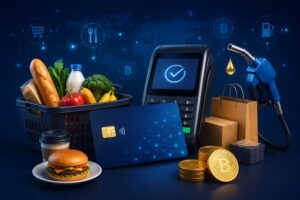
Crypto spending is moving into ordinary consumer routines, according to recent OKX Card data from Europe. The figures indicate that users are not primarily reaching for crypto-linked cards to make extravagant purchases. Instead, the strongest activity appears in categories tied to daily life, including groceries, meals, online shopping, convenience stores and transportation.
The analysis is based on settled OKX Card transactions recorded between January 28 and February 26, 2026, across markets in the European Economic Area where the card was available. The data should be read as a snapshot of early OKX Card usage in Europe, not as a full picture of global crypto payment behavior. Even so, it offers a useful view of how stablecoin and crypto-linked cards are entering consumer spending habits.
Supermarkets and Restaurants Lead Everyday Use
The clearest pattern in the data is the strength of food-related spending. Supermarkets and grocery stores accounted for 26 percent of transactions, making them the largest single category in the dataset. Restaurants represented 12 percent, while online marketplaces accounted for 13 percent.
When restaurants and fast food are grouped together, their combined share rises to 18 percent. Broader food-related spending, including groceries, restaurants and fast food, reached 44 percent of total transactions. That figure is important because it points to repeat, practical use rather than occasional luxury purchases.
The trend challenges the familiar image of crypto spending as being concentrated around high-end goods or speculative wealth. In this dataset, the more relevant picture is a weekly supermarket run, a quick lunch, a coffee, a delivery order or a small online purchase.
Country Trends Show Different Consumer Habits
The country-level details also show that crypto card usage is not developing in a single uniform pattern across Europe. Local shopping habits, payment preferences and everyday routines appear to shape how users turn crypto balances into real-world purchases.
- France: Bakery spending stood out as one of the most distinctive local patterns. Boulangeries and similar bakery merchants represented 5 percent of OKX Card transactions in France, compared with a European Economic Area average of 2 percent.
- Germany: Online marketplaces were the leading theme. In Germany, 30 percent of transactions took place through online marketplace merchants, more than double the European Economic Area average of 13 percent. The figures suggest that German users were particularly comfortable using crypto-linked cards in digital commerce.
- The Netherlands: Supermarkets were especially prominent. Dutch users recorded 37 percent of OKX Card transactions at supermarkets, the highest share highlighted in the data. Travel bookings and accommodation also approached a significant share of card volume, pointing to use in both routine grocery shopping and larger travel-related payments.
- Poland: Convenience stores and fuel spending were among the most visible categories. Convenience store transactions represented 16 percent of activity, while fuel stations also appeared as a notable everyday use case. This suggests a more mobility-focused pattern, with users applying crypto-linked cards to small-format retail and transport-related needs.
Stablecoins Enter The Checkout Experience
The OKX Card figures also feed into a wider discussion about stablecoins and their role in consumer payments. For years, crypto assets have been discussed mainly as investment products, trading instruments or tools for cross-border transfers. Card-based spending introduces a different question: whether stablecoins can become part of the checkout experience in ordinary commerce.
A crypto-linked card can give users access to digital asset balances while allowing merchants to receive payment through familiar card networks. In practice, the consumer experience can resemble a standard card payment, even if the funding source behind the transaction is connected to crypto or stablecoins.
This is why the data is noteworthy beyond OKX alone. If stablecoin-funded cards continue to gain traction, they could become a bridge between digital asset balances and everyday retail spending. The strongest early signal from the data is not luxury consumption, but routine spending behavior.
Data Should Be Read With Care
The findings are significant, but they should not be overstated. OKX did not disclose total transaction volume, the number of active users or the absolute number of payments behind each category. The data also covers a limited period of less than one month and reflects only OKX Card users in supported European Economic Area markets.
That means the results should not be interpreted as proof that crypto cards have become mainstream across Europe. They are better understood as an early usage signal from one product, in one region, over a defined period. Even with those limits, the direction is noteworthy: the story is about supermarket receipts, restaurant bills, online baskets, bakery purchases, fuel stops and travel bookings.