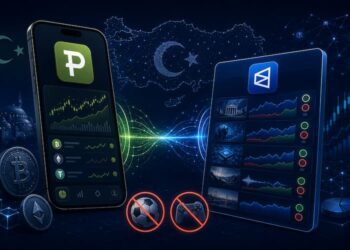
Transparency has long been seen as both one of crypto’s greatest strengths and one of its biggest weaknesses. The ability to track transactions on-chain supports trust and verifiability, but it also creates room for major orders to be detected early, opening the door to front-running, MEV pressure, and slippage-related issues. GoDark, which is preparing to launch on Solana, is stepping into that gap with a different model.
The new platform stands out for its attempt to make order flow more private. What makes the project especially notable is that it is being positioned not just for professional traders, but for retail participants as well. That raises the possibility that privacy-oriented trading infrastructure may no longer be reserved for institutions and high-volume desks alone.
What GoDark Brings to the Market
At its core, GoDark introduces a dark pool-style decentralized exchange model. The goal is to prevent the market from easily seeing users’ trading intentions and order details before execution. In practice, that could reduce the chance of large orders moving price prematurely while also shielding smaller traders from having their actions exposed too early.
Among the platform’s main features are:
- More private handling of order flow
- Reduced exposure to MEV and front-running
- Self-custody, allowing users to retain control of their assets
- An off-chain matching model with on-chain settlement
- The ability to benefit from Solana’s high-speed infrastructure
This points to a trading experience that differs from the standard DEX model. The fact that users can keep control of their wallets throughout the process may be particularly attractive for those who want to avoid the custody risks associated with centralized venues.
What It Means for Everyday Traders
One of the biggest questions surrounding GoDark is whether this privacy model genuinely applies to retail users. The answer appears to be yes. The platform is being presented not only as a tool for institutions or large block trades, but as a broader trading venue aimed at a wider market.
That said, the benefits are likely to play out differently depending on the user. For retail traders, the main advantage may be a less visible trading footprint, lower exposure to adverse price movement, and a more protected order flow. For larger market participants, the primary appeal is the ability to move significant size without pushing the market against themselves.
In other words, the value proposition for smaller traders is not absolute invisibility. It is more about a better protected trading environment. That makes it important to view GoDark’s privacy promise not as complete anonymity, but as a model centered on trade privacy.
Full Privacy or Limited Transaction Privacy?
In crypto, the word “privacy” is often misunderstood. GoDark’s model appears focused on hiding order details and reducing visibility into trading flow as much as possible. But that does not mean a user’s entire on-chain existence suddenly becomes impossible to trace.
A wallet’s funding sources, its previous transaction history, and the paths assets took before reaching the platform can still provide clues when analyzed alongside public blockchain data. For that reason, the real distinction here is not total invisibility at the address level, but protection of trading intent and execution strategy.
That is a key difference for market participants. The real innovation is not complete anonymity, but the possibility of less exposed order flow and a more efficient execution layer.
Liquidity May Be the Real Test
The factor most likely to determine GoDark’s success is not just the technology itself, but liquidity. No matter how advanced a privacy-focused trading system may be, it still needs strong volume and reliable counterparties to deliver a smooth experience.
That means the platform will have to prove more than its technical design. It will also need consistent market maker participation and sustainable trading activity. In a competitive Solana ecosystem, attracting and retaining users will depend on balancing speed, execution quality, and depth.
If liquidity develops as expected, GoDark could grow into more than a niche privacy product and become a meaningful alternative in the DEX space. If it does not, the platform may still attract attention for its design while seeing more limited adoption in practice.
A New Chapter for Solana’s DeFi Landscape
GoDark’s planned launch on Solana in May is more than just another platform debut. It also signals that privacy-oriented DeFi infrastructure could become a more prominent theme in the ecosystem. Topics such as order protection, execution privacy, and user control are likely to gain more attention in the months ahead.
Overall, GoDark stands out as a notable attempt to address the crypto market’s growing demand for privacy. The fact that it is being positioned as accessible to everyday users as well makes it more than just an institutional trading tool. Still, its real impact will depend on how it performs in live conditions, how deep its liquidity becomes, and how users respond once it is active. For now, one thing is already clear: on Solana, the next phase of the privacy-focused DEX narrative is beginning to take shape.