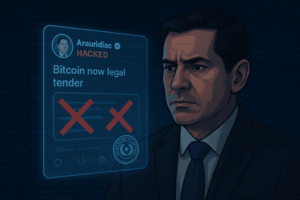
On June 9, 2025, a post on Paraguayan President Santiago Peña’s account on X (formerly Twitter) claiming that Bitcoin had been declared legal tender in the country caused a major stir in crypto circles. However, it soon became clear that the announcement had not come from the President himself, but that his account had been compromised by malicious actors. The Paraguayan government announced that the posts were swiftly deleted and that cyber security units had been mobilized. The scale of the disinformation and the exploitation of public interest in crypto highlighted the region’s digital security vulnerabilities.
Legal Tender Announcement Shakes Social Media
The post on President Santiago Peña’s X account declared that the country had recognized Bitcoin as an official and legal currency. The message appeared in both Spanish and English and carried the tone and imagery of an official state announcement. It even claimed that the Paraguayan government had created a $5 million Bitcoin reserve fund.
The speed at which the post spread was largely due to expectations within the global crypto community and Latin American investors that Paraguay might take such a step. The precedent set by El Salvador made the claim appear more credible. Within hours, thousands of users shared the post, while some exchange-tracking bots and investment-focused news outlets even reported it as breaking news.
However, the tone, timing, and investment solicitation within the message raised suspicions among experts. Users were urged to contribute via a link included in the post, which prompted warnings of potential fraud. The incident once again demonstrated how quickly misinformation can spread on social media.
Paraguayan Government Responds Swiftly
After the post spread, the Paraguayan government issued an official statement. It confirmed that “suspicious activity” had been detected on the President’s X account and that it had been compromised by malicious actors. The government emphasized that the Bitcoin announcement was entirely false and had no connection to state policy.
The country’s national cyber security unit was activated following the incident. Working in coordination with X, officials launched a technical investigation to secure the account and identify the source of the attack. Initial findings suggested the hack may have originated abroad.
The Paraguayan Ministry of Foreign Affairs also issued a statement, urging citizens not to trust unverified content and to follow official announcements only through authorized government channels. It specifically warned against clicking on links soliciting investments or contributions.
Although the account was quickly secured, the incident sparked new debates on social media’s reliability and the vulnerability of public authorities on these platforms.
Rising Crypto Scams in Latin America
The incident in Paraguay is the latest in a series of cryptocurrency-related scams in Latin America. In many countries in the region, economic instability and distrust of traditional financial systems have fueled massive interest in crypto—unfortunately making them a target for fraudsters.
In Paraguay, the absence of clear regulatory frameworks around crypto increases the impact of such schemes. In May 2025, cyberattacks targeted at least 13 public institutions, exposing weaknesses in the country’s digital security infrastructure. While cybersecurity reforms were discussed afterward, concrete implementation has yet to follow.
The fact that El Salvador declared Bitcoin legal tender in 2021 also raised expectations that other nations might follow suit, making the Paraguayan hoax more believable.
Experts warn that crypto scams run through social media pose risks not just for individual investors but also for national reputation and international relations. Similar scams have previously used the names of government officials, mayors, and public figures across Latin America, tricking thousands into fraudulent “investment opportunities.”
Disinformation Threat in the Age of Information Security
The hacking of the Paraguayan President’s social media account underscored once again how fragile information security is in the digital age. When political leaders, state officials, and public institutions are targeted, the consequences extend beyond individuals to society at large. Fake statements can not only sway investment decisions but also manipulate perceptions of government policy.
This is not unique to Paraguay. In Turkey, for example, the accounts of high-profile individuals have also been hacked in recent years, spreading similar disinformation campaigns. Cryptocurrencies, with their promise of quick profits, are often used as bait. In some cases, fake investment announcements bearing ministry logos created the illusion of “state-backed crypto projects,” defrauding citizens.
Experts stress that in societies with low levels of digital literacy, such attacks have a greater impact. They emphasize that users must develop the habit of questioning information sources, especially when content involves economic or political claims.
In the digital world, information spreads quickly—but can be manipulated just as fast. Recent incidents in both Paraguay and Turkey highlight that one of the greatest challenges of the social media era is ensuring access to reliable information.